
Agents let people assign outcomes. Automation changes when assignment happens: recurring work can begin according to an established arrangement without waiting for someone to remember to ask. The product takes on an ongoing responsibility.
That responsibility cannot live only in a scheduled prompt. Methods may improve, this week's inputs may differ, and the time may change. Binding them together makes automation hard to explain and eventually something users can only delete and rebuild.
Teloa retains method, triggering arrangements, and each instance of work separately. Community currently organizes recurring execution primarily through scheduled plans. Roles and skills retain how to work, each task and run records actual processing, and artifacts remain subject to their own delivery requirements.
Do it once to discover the actual requirements
Suppose a customer-issues brief is needed every Monday. The person responsible needs to know what awaits confirmation, its supporting evidence, and the deadlines in order to arrange follow-up.
The first delivery may expose requirements that were never clear: whether duplicate mentions of one matter should be combined, how to express a missing date, and whether an unchanged week still needs a full report. Without trying the work once, it is hard to anticipate everything through configuration.
Resolve those differences in a usable result before deciding which requirements are stable. Increasing frequency first would only reproduce the same errors faster. A person could move from preparing by hand to editing by hand without reducing the burden.
Once the brief is accepted, it can help identify the method worth retaining: how to combine duplicate matters, present evidence, and mark missing deadlines. This week's clients and dates remain inputs for each occurrence. Turning a finished report directly into a fixed prompt could otherwise keep next week's work focused on last week's subjects.
Community already has a path from an owner-accepted, fixed artifact version to a skill or plan draft. A skill develops how future work should proceed; a plan prepares when it should run, who should do it, and what to deliver. The draft is still checked in its original creator. Requirements already developed become a starting point for reuse without being described again in a new chat. One accepted result still does not establish that the whole process is reliable.
Methods and plans can be adopted separately. A weekly brief need not create both. If an existing role and skill already cover the work, add only the triggering arrangement. If the next assignment will still be manual, retain the checking procedure as a skill first. This combination lets ongoing responsibility grow gradually.
The plan describes the arrangement; history records what happened
A plan records who is responsible, the goal, timing rules, time zone, and necessary inputs. Saving and enabling are separate actions, and each occurrence links to its own task and execution.
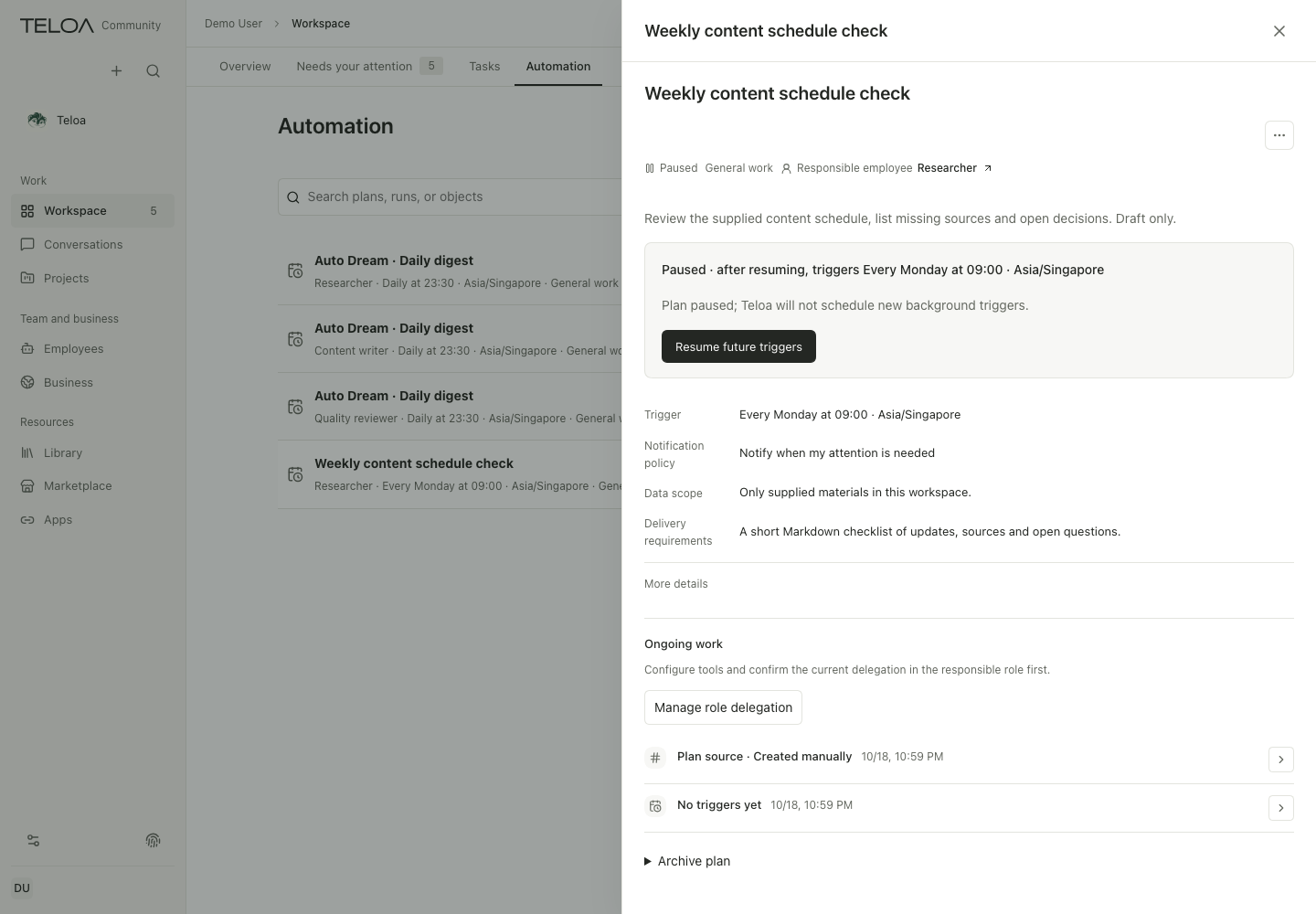
Last week's completion says nothing about whether this week's work has run. An enabled plan does not establish that the latest deliverable has been accepted. Users need both arrangement and history to know whether the work happened as expected.
The time zone is part of the assignment's meaning. A Monday-morning briefing needs a definite region's Monday. Otherwise, the same timing rule may create different expectations after an environment migration or a change in how it is viewed.
Continuing automation depends on continuing input validity
A plan may trigger on time while material has become outdated, a connection is unavailable, or model configuration has changed. Success once does not make later inputs valid forever.
Each occurrence must follow current operating conditions. If this week's material cannot be obtained, it should not silently reuse old content and call it this week's result. If the output is incomplete, the person responsible should be able to identify the gaps rather than seeing only a normal timestamp.
Community plans require an available execution environment, model, and relevant connections. Maintaining a recurring arrangement includes these operating conditions.
A maintainable weekly report contains three changing elements: the checking method, this week's material, and when work starts. Excessive length calls for a method change. Missing clients call for an input check. Unsuitable delivery time calls for a schedule change. One scheduled prompt containing everything couples these adjustments unnecessarily.
“No new matters” and “material unavailable” particularly need different treatment in the method. The first may need no lengthy report; the second needs an account of missing inputs. A time rule cannot decide between them. Work requirements and delivery review must address the distinction.
Pausing still leaves the current work with a home
A role's scheduled plan keeps two operations separate:
- Pause the plan: control only later triggers.
- Stop the current occurrence: end execution from the corresponding task; history and deliverables remain available.
Separate actions let users change future arrangements and handle current work independently.
Maintenance then has a place:
- Change the method in the skill or role.
- Change timing in the plan.
- Investigate a specific failure in its run.
- Leave feedback on the corresponding deliverable.
Different problems do not all need to be solved by deleting and recreating the setup.
Higher frequency still needs worthwhile results
Automation keeps consuming preparation, compute, and human attention, so it needs continuing evaluation. A report that arrives on time without informing any decision may simply turn manual routine into automated noise.
Frequency and content should change with the work. Reducing frequency, pausing a plan, or revising the method can be normal signs of mature automation. Useful history and methods need not disappear with those adjustments.
We want people to retain a working arrangement worth continuing. It has a basis for starting, a place to explain each occurrence, and room for its owner to reconsider whether it is still needed.