
Two companies may need very different deliveries from the same “alert investigation.” One cares first about effects on critical assets; another checks whether activity occurred during an authorized test window. Roles, tools, and pages may look similar while professional judgment depends on different conditions.
This is why copying a prompt rarely delivers an industry solution. Useful experience includes the questions that must be checked, how evidence supports a conclusion, how missing conditions are handled, and who takes the result forward. The recipient needs these methods while retaining its own data meanings and response rules.
Teloa combines roles, skills, connections, and business structure to express a working method. Its resource format preserves composition and dependencies. Whether a solution fits another company still has to be tested against that company’s material, rules, and an actual delivery.
What professional experience needs to carry
Consider a hypothetical security operations solution, rather than a delivered customer project. It helps investigate suspicious-login alerts and produces a report containing evidence, an assessment, unresolved conditions, and response recommendations.
Some steps should travel with the method: checking the alert time, identifying the account and asset, comparing relevant evidence, and stating the limits of the conclusion. Without them, the recipient gets a role description capable of writing security reports but still has to rebuild the investigation method.
Other decisions belong to the recipient: what counts as a critical asset, how test windows are confirmed, and which findings require escalation. Hard-coding the source company’s answers may make the solution run smoothly while consistently producing unsuitable judgments in the new environment.
| Content | How to handle it during reuse |
|---|---|
| Essential checks | Preserve the steps, required evidence, and delivery standard |
| Conditions that depend on company policy | Make them explicit and have the recipient confirm their local meaning |
| Accounts, data, and tool permissions | Establish them using the recipient’s own material, connections, and authorization |
This distinction gives industry experience both substance and specific places for adaptation. A blanket instruction to “adjust as needed” leaves too much unresolved. Guessing business rules for an immediate demonstration is no better.
The same field name may carry a different meaning
Suppose the source solution uses “high severity” for an alert’s original rating, while the recipient uses it for an incident rating confirmed after investigation. Both systems can save and display the field, yet subsequent handling may be wrong.
The first is an investigation input; the second already contains a judgment. Matching only the names and counting both values as “confirmed high-severity incidents” would include alerts before investigation confirms them. Valid configuration and a successful import cannot rule out this semantic difference.
Industry adaptation therefore needs more than matching field names. It must explain who produces each piece of information, which stage it belongs to, and what justifies a change. An AI recommendation, an adopted assessment, and an action actually carried out also need distinguishable meanings.
Teloa’s current objects, fields, states, and configuration drafts provide a place to inspect these definitions. They do not automatically detect the two companies’ different interpretations of “high severity.” Professional adaptation still requires explicit rules and checks against local material.
Combining resources makes a method usable
An investigation method rarely lives in one file. A research role needs the relevant skill, tool connections need to supply evidence, and business objects need to hold alerts and investigation results. If one part is missing, the user still has to make the connection.
Teloa’s sharing format distinguishes employees, teams, applications, skills, and MCP resources, and expresses composition and dependencies. It preserves agreements about which role uses which method and which external capabilities it needs, giving the recipient a working starting point to inspect.
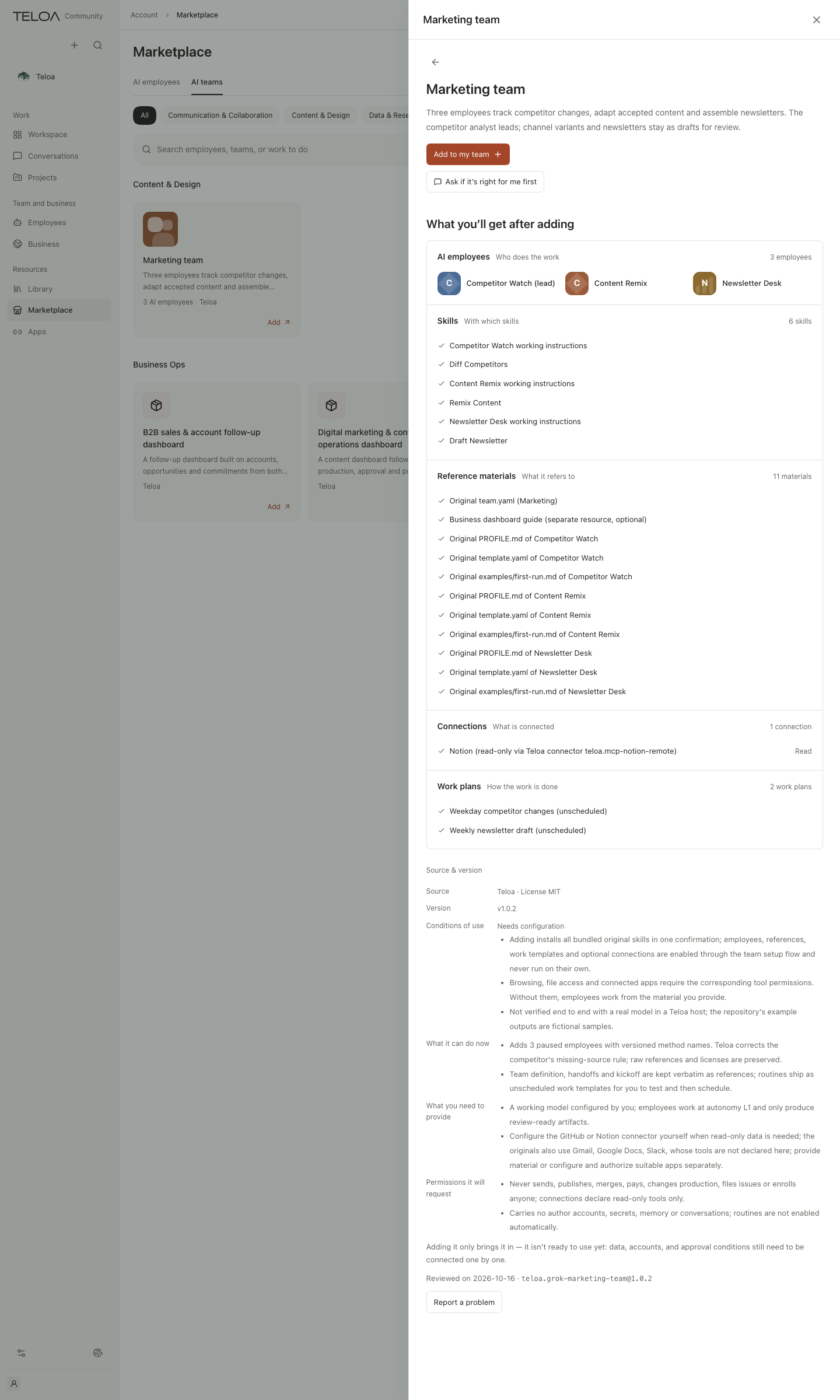
Templates do not include the source company’s customer records, conversations, work results, credentials, synchronization bindings, or authorization instances by default. The recipient establishes its own operating conditions, inspects drafts and dependencies, and then decides what to adopt. The method travels; operational data and permission to act are established separately.
This changes the solution author’s delivery responsibility. Once the author’s accounts and data are removed, can another user still identify what is missing, prepare it, and assess the result? Experience that works only in its author’s familiar environment has not yet become a deliverable method.
Test the transfer through one local delivery
Return to the suspicious-login investigation. The recipient can begin with one alert and related material it is authorized to use, without enabling continuous operation at the outset.
The delivery should answer specific questions. Do the account and asset correspond to local objects? Can conclusions be traced to evidence? Does the report leave conditions unresolved when necessary information, such as a test window, is missing? Do recommendations follow the company’s own rules? These checks test whether the method holds in the new setting.
Even a complete report may reveal needed changes. The source method may be useful while a local evidence source is unavailable; the delivery should then state that limitation. A local review role may require a different division of work. Adaptation can focus on these professional differences instead of rebuilding the execution foundation each time.
As the source changes, business configurations and dashboard templates can use a three-way comparison of the original source, current local version, and candidate update. Employees, skills, and other solution resources instead require item-by-item choices, such as retaining a resource or adopting its candidate where the specific change allows; local text edits still need human review. These update paths support maintenance, while the initial check of business meaning still needs a local delivery.
An industry solution should give its user a method they can understand, test, and adjust. A template lowers the cost of starting; a local delivery determines which experience is worth keeping.