
After AI generates material, an employee, or a skill, users soon edit it elsewhere. If the original chat retains another independent copy, easier generation creates more synchronization problems later.
Natural language needs to do more than generate and save once to become a lasting work interface. It must address existing objects, recognize current versions, and follow the same rules as interface actions.
We choose to have supported natural-language resource operations call the original services. The model organizes intent; the resource service decides whether a change is valid, how to save it, and what to return. The same resource can then continue to be maintained through conversation and interface.
A sentence needs to resolve to a specific object
Suppose an assistant first saves a service description. The initial operation needs the text and its folder; a later request to “make the conditions more specific” first needs the original material and its current version.
References are convenient in natural language, but can also be ambiguous. “It” may mean the summary just generated or an existing description in the knowledge library. The product cannot turn a guess about meaning directly into an edit to another object.
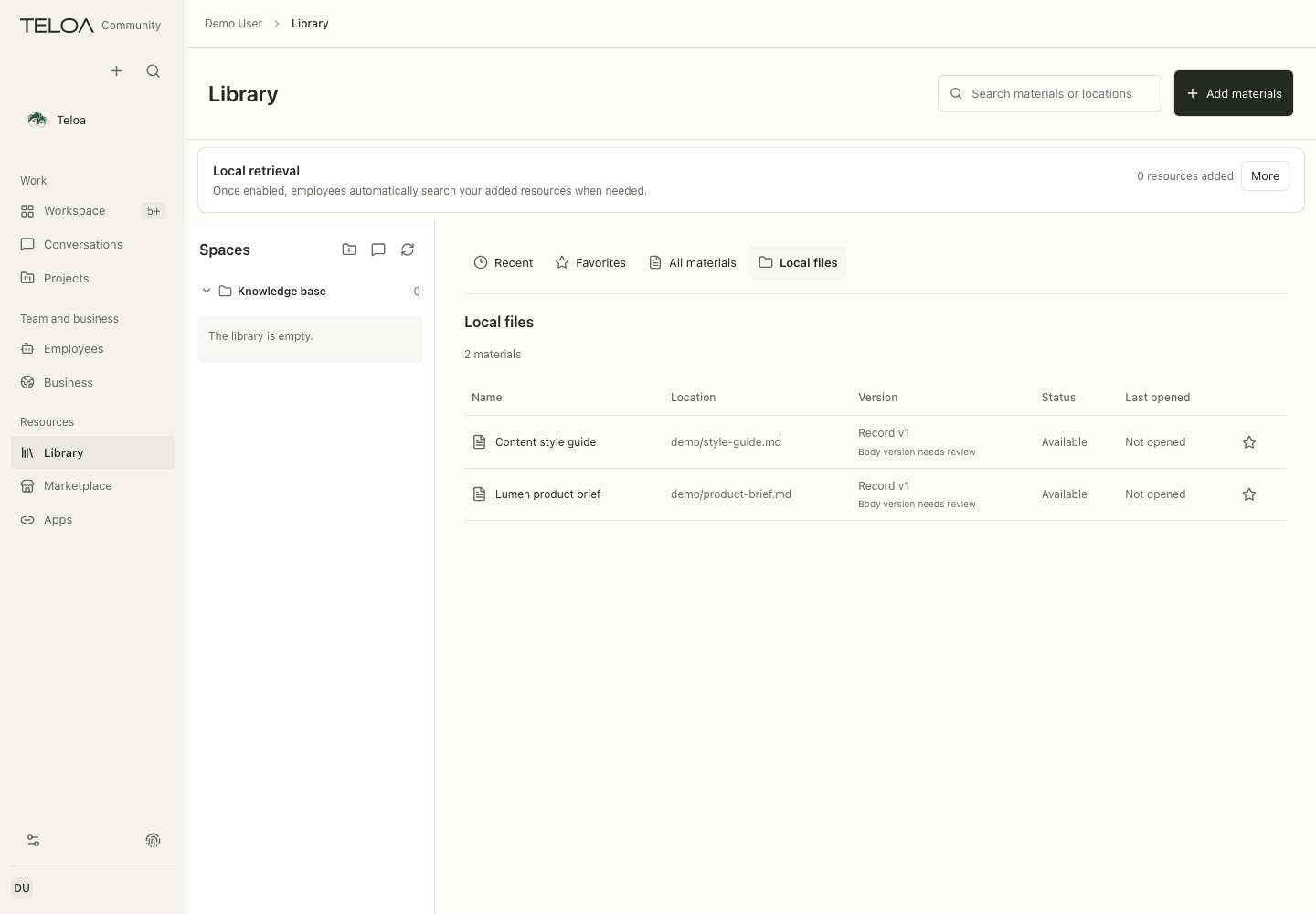
Natural language turns the request into a currently supported resource action, and the original service saves the result. The response points to the actual object, whose name the user can click to open in the management interface. A name aids recognition. The identity and version of the same resource establish that later changes will not land on another similar entry.
One service preserves one set of write rules
A separate save implementation for the natural-language entry point could easily bypass the interface's version checks, scope, and cancellation handling. The two entry points might appear consistent until concurrent changes reveal their differences.
Employees, groups, knowledge, skills, and supported connection configurations are maintained through their original objects, with the existing version and scope checks reused alongside them. Natural language adds a way to express a request without creating another resource copy that bypasses the rules.
Suppose you update a service description in the interface while the conversation still has an old version for its next edit. The system needs to recognize the version change and avoid silently overwriting what you just wrote. Old versions explain the past; new versions are available for later use. “Last save wins” cannot handle every conflict.
Engineering-wise, natural language and the interface should share mutation capabilities, rather than merely write to the same table. Target resolution, input validation, version conflicts, scope, and receipts need the same rules. Otherwise chat might bypass a change the interface would prevent, making the two entry points different operations.
The model organizes requirements into supported actions and parameters; the service determines validity and persistence. This limits arbitrary interface invention but lets users express complex requirements conversationally and inspect the result precisely. Expression becomes flexible while system rules remain stable.
It is also necessary for moving from generation to maintenance. Resources remain in their original management system, giving versions, adoption, and use a common home. Users need not keep returning to the conversation that first created them.
Saving should not silently take the next step
A skill revision is the clearest example. You ask to “Add a source-checking step.” Saving should create a new version of the same skill. Which version existing employees use, and whether the skill is enabled, remain separate decisions.
Otherwise, what looks like a local text edit could change employees already doing business work. The user intended to improve a method first, but unknowingly expanded the effect of the change.
Other resources need similar distinctions:
| What has been saved | What it does not establish |
|---|---|
| A new version of the same skill | Existing employees have switched to it, or the skill is enabled |
| Document content | Every employee and group has permission to read it |
| A connection definition | External authentication is complete |
The receipt needs to state how far the action actually went, with subsequent actions continuing from the original entry point.
This preserves the usefulness of natural language. Users can confidently prepare changes with a brief request because the system will not infer a chain of installation, enabling, authorization, or publishing from an instruction to save.
Conversation helps express a change; the interface supports close inspection
The two forms suit different stages. A business owner can readily explain in a paragraph what a service description omits and where readers may misunderstand it. Fields and text arranged for inspection make prices, conditions, and saved versions easier to check. Retaining both lets people change how they express themselves as the problem changes.
The service description illustrates the round trip. Develop the explanation in chat, follow the result to the original document, then check and revise its conditions. A later request to add examples still needs to read that document's current version. Having a role adopt the material is another explicit resource choice. Expression, inspection, and use each have a place without requiring the user to copy the whole text to keep them synchronized.
Natural language can then participate in a resource's continuing maintenance. A change leaves an object that can be read, edited, and adopted later. The original chat explains why it was created without remaining the only place it can be found.