
A business page generated from one sentence makes its strongest demonstration at first creation. Once it is used, different questions appear: will a new stage still explain old records, do lists and dashboards use the same meaning, and will the next request produce a separate system again?
These questions determine Teloa's approach. AI helps develop a business definition, and the result is expressed through currently supported objects, fields, views, and pages. Natural language lowers the cost of expression; shared structure gives the generated business a basis for continued use.
This limits what can be generated while retaining consistency for queries, changes, and upgrades. For a small-business system meant to last, the cost of the second modification belongs in the first design decision.
Begin with what one real item needs
Suppose someone is following a batch of quotes and wants to know who has not confirmed. They first need customer names, quote stages, expiry dates, and unresolved conditions. A polished list without those field definitions leaves later filtering and dashboards guessing from text.
“Stage” is especially easy to leave ambiguous. Three facts need to stay distinct:
- The quotation has been sent.
- The customer is reviewing it.
- The customer has accepted the quotation.
Putting them in one free-text field is convenient at first, but makes later comparisons difficult.
Business modeling turns these differences into meaningful fields and options. Unknown values can wait for more information; they should not be invented to complete the page. Nor does every situation a company might encounter need to be designed in advance.
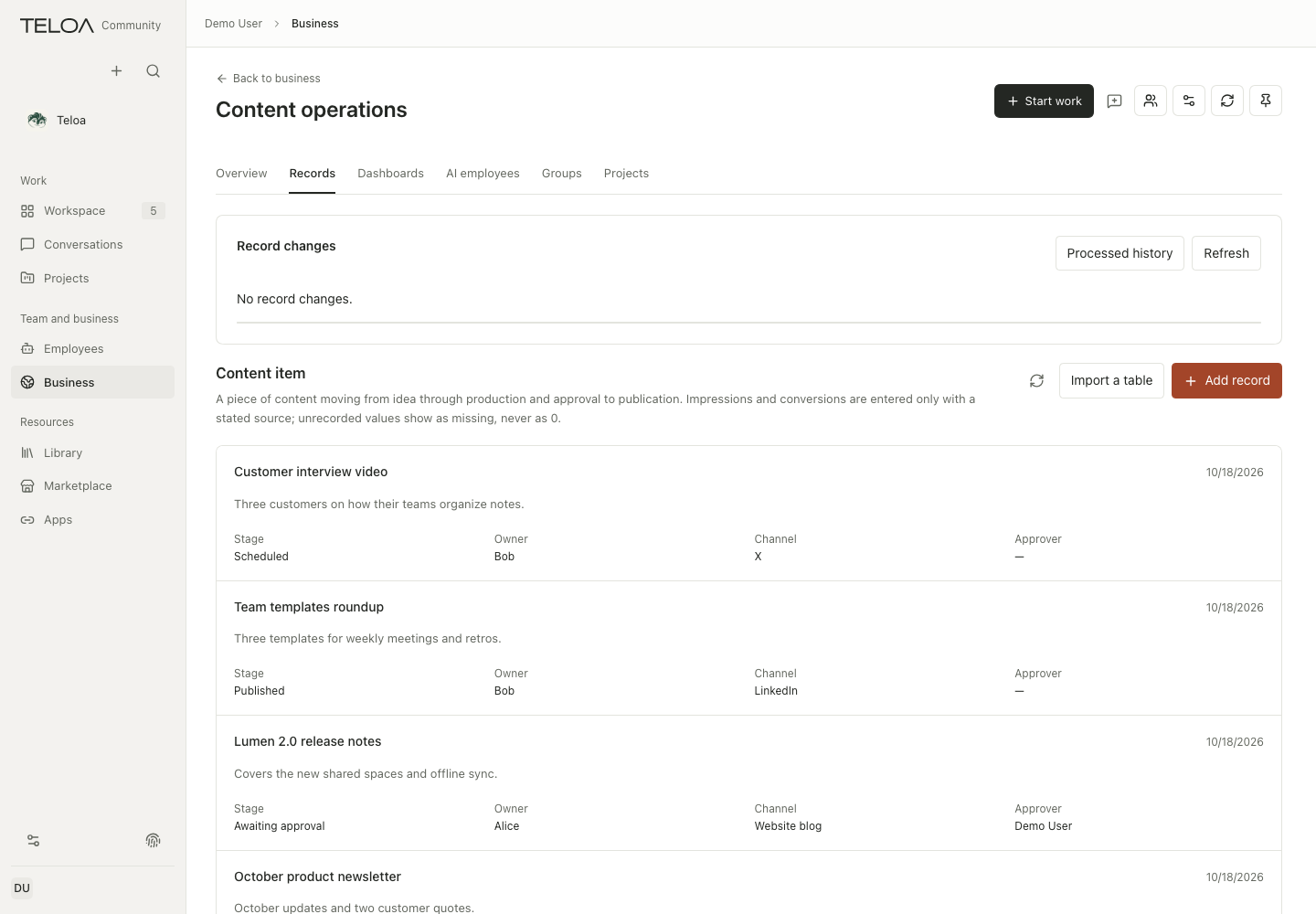
One definition supports different ways of looking at the work
Record details help with an individual customer, a list helps find items, and a dashboard provides an overall view. They should use the same business objects and fields, rather than maintain similar copies of the data.
For example, the dashboard’s count of items awaiting confirmation should come from the agreed stage criteria. On opening a specific record, the user should be able to explain why that customer is included. If each page has its own model-written description, the same label may conceal different definitions.
We choose constrained business modeling here rather than generating a separate application page for every request. Free generation can quickly show different appearances. The harder problem arrives with the second change: whether the field retains its identity, lists and statistics share its meaning, and existing records remain readable.
Supported objects, fields, views, and pages form a shared structure. AI organizes expression into candidate configuration; the original business service validates, previews, and adopts it. The model helps form definitions without reinventing storage, filtering, and upgrades each time. The trade-off is a scope bounded by current configuration capabilities.
That constraint serves continuing use. Adding a stage in the second week of client follow-up should change the existing business and inspect historical impact. Receiving a new page each time would turn initial convenience into migration and reconciliation work. Natural language should lower maintenance costs beyond the first demonstration.
A draft gives requirements a chance to be corrected
Initial requests are usually incomplete. You ask for a follow-up date, then realize on seeing the draft that the customer-agreed date and the internal reminder should be separate. Conversation can refine the request. Draft preview provides a place to inspect and save the structure.
A draft makes abstract requirements easier to understand. A paragraph of configuration may not expose the ambiguity in “follow-up date.” Seeing it arranged alongside the customer stage can make the missing condition apparent. Preview should help the business user judge the design, rather than merely show that generation succeeded.
Once the structure is settled, AI work can be connected to a specific item. In the quotation example, the list identifies clients awaiting confirmation. The owner starts a check from one record, an employee uses permitted material to explain unresolved conditions, and any proposed change becomes a reviewable draft. Actual adoption updates the formal record; the dashboard then calculates from the same field definitions. Each step continues to use the original business object, reducing the need to reconcile client identity across reports, spreadsheets, and chat.
Structure gives judgment a shared language. Fields and stages let people compare items, an employee explains why one deserves attention, and tasks and artifacts carry the specific work. Without the structure, each analysis may redefine “awaiting confirmation.” With structure alone, the owner still has to read all the material and develop the next step. Connecting them lets AI participate in the existing business rather than merely generate another page.
These parts still need to be established through actual capabilities and permissions; saving the business does not start them all. Trying a few local records before preparing employees, material, and connections lets the owner revise a definition as gaps appear, rather than debug an entire recurring workflow at once.
Modeling continues after the system enters use
Business modeling does not end when a draft is saved. Adding a review stage, changing a field type, or narrowing options changes how existing records can be understood. Current upgrade-impact checks identify relevant incompatibilities; a valid new configuration cannot substitute for handling old data.
Natural language consequently needs to keep serving the same business definition. People discover requirements through use, AI helps organize changes, and the original service checks and saves them. Creation and maintenance become parts of the same work.
Generation speed matters when the result has a definite later life. Records that remain usable and meanings that can change consistently give the business a chance to retain working capability of its own.