

Looking back at how AI products have developed over the past few years, a direction is becoming increasingly clear: AI is moving from answering questions to taking on work.
At first, our relationship with AI lived in a chat box. A person asked a question, and AI supplied an answer. Then came copilots, bringing AI into IDEs, office applications, browsers, and other work software. People still controlled the actions, but AI was beginning to work alongside them.
Next came workflows, through products such as Dify and n8n. People started handing entire processes to a system, but those processes were still largely designed in advance. What to do next, which tools to call, and how to handle failure generally had to be defined beforehand.
Agents changed that. Instead of telling AI what to do in step one and step two, people could tell it the outcome they wanted. The agent would break down the task, make a plan, call tools, visit websites, work with files, execute code, and decide what to do next based on the results along the way.
The real change is more than models becoming smarter. More of the responsibility for planning and executing tasks is moving from people to AI.
01 | From Agent to Harness: AI Starts Taking on Real Work
Running an agent for a few minutes is relatively straightforward. Completing work that takes an hour, a day, or longer requires much more than a single model call.
The agent needs to manage context, preserve state, call tools, operate files and browsers, execute code, handle failures and retries, and distinguish actions it can take independently from those that require human approval.
An increasingly important layer of infrastructure has therefore emerged behind the agent: the Agent Harness, or Agent Runtime.
The model determines how intelligent an agent is. The harness determines whether it can actually finish the work.
Coding was one of the first areas to demonstrate the value of harnesses at scale. Claude Code and Codex let developers delegate increasingly complete software engineering tasks to agents: understanding a codebase, modifying files, executing commands, running tests, calling tools, and improving their work through feedback.
Coding is a natural environment for testing a harness. The tasks are complex, the tools are rich, and compilation, tests, and Git diffs provide ongoing feedback. Coding agents became one of the earliest proving grounds where harnesses matured.
OpenClaw then carried this way of working beyond coding and into a broader personal computing environment. Agents no longer had to live only in an IDE or terminal. They could remain active on a person's computer and communication channels, with workspaces, sessions, memory, skills, and automation, and keep moving tasks forward.
Claude Code and Codex showed that a harness could make agents work in complex software engineering environments. OpenClaw helped more people see that this operating model could also underpin a personal agent.
By 2026, harnesses themselves were becoming more visible as infrastructure. The Codex harness, Claude Agent SDK, and DeepSeek Harness (DSH) all point toward the same development: the harness is evolving from an engineering implementation inside a particular product into a software layer that can be selected, extended, and developed independently.
DSH takes this further as a standalone open-source project, using a plugin architecture to bring together models, tools, sessions, file access, and the agent loop.
We believe that, after large language models, the Agent Harness could become a critical layer in the next wave of AI application infrastructure.
Teloa currently uses DeepSeek Harness as its Agent Runtime. At the product level, however, we want AI employees to be as independent as possible from any particular model or harness. Models and runtimes can evolve; the identity, memory, capabilities, and working relationships an AI employee builds over time should endure.
02 | From a One-Off Agent to a Lasting Work Role
The next step for agents is more than running longer. It is continuing to grow.
Products such as Hermes Agent are beginning to emphasize persistent memory, skills, and continuous learning. An agent can remember users, projects, and environments across sessions, and turn the methods it develops while solving problems into skills it can reuse later.
An agent can thereby develop from a one-off task executor into a lasting work role that accumulates experience.
At the same time, AI is entering the workplace more directly. Products such as Doubao for Work and QwenWork are moving AI from a question-and-answer tool toward a starting point for work. Users describe their goals, and agents handle documents, spreadsheets, websites, and code, drawing on skills, connectors, and other tools to deliver results.
Personal agents go a step further. Meta's Muse builds an ongoing understanding of its user, connects to applications, and continues working on projects and goals. WorkBuddy organizes work through experts, skills, memory, authorized tools, and expert teams for parallel collaboration. Cue, a standalone app introduced alongside Manus 2.0, gives agents their own email addresses, phone numbers, wallets, and computers. Its agents can divide work and hand tasks to one another in group chats, and handle certain real-world services on a user's behalf.
At this point, an agent is more than a program that calls tools. It begins to have an identity, communication capabilities, accounts, resources, and boundaries on its actions.
Muse Gadgets extends this direction from software into devices and physical environments. Interfaces for Raspberry Pi, ESP32, sensors, displays, and actuators open up the possibility of personal agents connecting to the real world.
AI's reach is expanding from information into software, and gradually into the physical world.
03 | From Agent to AI Employee
In Teloa, we call an agent that works over the long term an AI employee.
A digital role that truly participates in work needs more than a prompt. It needs a complete set of work attributes:
Role + Identity + Knowledge + Skills + Tools + Memory + Permissions
Role defines what it is responsible for. Identity establishes it as a lasting entity. Knowledge provides the context and evidence for its work. Skills are the methods it has learned. Tools enable it to act. Memory lets it accumulate context over time. Permissions define which actions it can take independently, which require human approval, and when it must escalate to a person.
“Agent” describes a technical capability. “Employee” describes a place within an organization.
An agent with a lasting presence, responsibilities, identity, and permissions begins to resemble an AI employee. When multiple AI employees with different roles work together, they begin to form an AI team.
04 | The Next Step for the Personal Agent Is the AI Team
When someone has a single persistent agent, it is natural to think of it as a personal agent.
But imagine someone with several AI employees: a research analyst, a product manager, a software engineer, a content marketer, and a security engineer. Each has its own responsibilities, knowledge, skills, tools, memory, and permissions. They can discuss work, collaborate, and hand tasks to one another. The shape of the product begins to change.
It becomes an AI team.
This is the problem Teloa is working to solve today:
How can a person truly own, manage, and run an AI team?
Today, Teloa is first and foremost an AI-Native Team Studio. We start with AI employees, defining lasting work roles through responsibilities, knowledge, skills, tools, memory, and permissions. Through tasks, projects, group collaboration, and automation, we bring multiple AI employees together into an AI team that can do real work.
05 | Beyond the AI Team May Be the AI Organization
The AI team may not be the endpoint.
A real organization is more than a collection of people working together. It also has roles, responsibilities, hierarchy, resources, budgets, permissions, processes, governance, and organizational memory built over time.
As the number of AI employees grows, a group chat alone will struggle to support lasting collaboration. Task delegation, dependencies, resource allocation, approval chains, permission boundaries, and accountability will emerge among AI employees. Multiple AI teams may also take on distinct functions such as engineering, security, operations, sales, and customer support.
Group chat is only the visible surface of collaboration. An organization also needs roles, permissions, resources, approvals, governance, and organizational memory.
Over a longer horizon, the direction could be:
AI Employee → AI Team → AI Organization
The next stage of AI could extend beyond teams into organizations.
Future AI organizations will also reach beyond chat boxes and office applications. They will connect to models, data, SaaS, payments, and communication networks. They may go on to connect to devices, IoT, sensors, robots, and real-world services.
The digital world and the physical world could together become the environment in which future AI organizations connect and operate.
06 | Greater AI Autonomy Makes Security, Identity, and Governance More Important
When AI was a chatbot, our main concern was usually whether it would give the wrong answer.
Once an AI has an email account, wallet, browser, computer, and access to business systems, the questions change completely. Who is it? Who authorized it? Whom can it represent? What data can it access? Which actions can it take independently, and which need approval? If something goes wrong, how do we stop it, isolate it, and recover?
The more useful an agent becomes, the more data it needs. The more autonomous it becomes, the more access it may require.
AI employees are therefore a matter of identity, permissions, and governance as well as productivity.
For Teloa, the next generation of AI infrastructure must make agents more autonomous while keeping that autonomy within clear boundaries for identity, permissions, approval, and audit.
Security, identity, permissions, and data ownership are foundations for bringing AI into production. They must be designed in from the beginning.
07 | Who Owns the AI Team?
Switching a chat model today is relatively easy. Moving from GPT to Claude, or from Claude to DeepSeek, usually means changing the model.
But an AI employee that has worked with you for a year may have accumulated persistent memory, business knowledge, skills, tool connections, past tasks, files, account permissions, and working relationships with other employees.
What you are migrating at this point is more than a chat history. It is a digital employee that already understands you, understands your business, and knows how to work.
If you own an entire AI team, what needs to move could be a whole digital organization.
That is why Teloa cares deeply about this question: who owns the AI team?
Models can be replaced. Harnesses can evolve. Deployments can move. Compute can be chosen. Your AI team remains yours.
What needs to endure is the AI employees' and team's identity, memory, knowledge, skills, tools, permissions, tasks, and collaborative relationships.
Private deployment is one way to achieve this. The deeper principle is ownership.
08 | From Token Dependency to Control over Compute
Most AI products today obtain their intelligence primarily from cloud model APIs. Every inference and every agent loop consumes tokens.
That cost may be less noticeable in a chat product. When agents run continuously, however, and one person manages five, ten, or more AI employees, tokens become a significant operating cost for an AI team.
We believe the future is more likely to bring a layered, hybrid architecture for intelligence:
Device → Edge → Private Infrastructure → Cloud → Frontier Model
Small on-device models can handle low-latency, privacy-sensitive, and frequently repeated tasks. Edge nodes can serve stores, factories, home gateways, vehicles, and robots. Local GPUs and private enterprise models can support proprietary data and stable workloads. A user's own cloud can coordinate work at a larger scale. The most capable frontier models can then be called when needed for difficult reasoning and high-value tasks.
The harness would choose models and execution environments dynamically across these layers, taking into account task difficulty, data sensitivity, response-time requirements, network conditions, available compute, and cost.
As open models, small models, inference optimization, and on-device compute continue to advance, more work that requires an API today could run on personal computers, AI PCs, workstations, enterprise servers, or a user's own cloud.
This would give people greater control over their data and change the economics of AI.
Today, we continually buy inference from model providers through tokens. In the future, more inference may run on compute we own, shifting costs toward owning and scheduling our own computing resources.
From renting tokens to owning intelligence.
This is another dimension of ownership for Teloa: control over data, models, harnesses, and compute.
09 | Teloa Starts with the AI Team
Along this path, Teloa's direction has become increasingly clear.
Today, Teloa is an AI-Native Team Studio.
Our direction for the next stage is:
Open AI Team Infrastructure for the Real World
Infrastructure for individuals and enterprises, connecting the digital and physical worlds.
Individuals, independent developers, one-person companies, and small teams can have their own AI employees, build their own AI teams, and hand over substantial amounts of repetitive execution work.
For enterprises, AI teams can extend further into corporate knowledge, identity systems, permissions, approvals, audit, business systems, and organizational governance, gradually forming a new AI workforce.
Teloa starts with AI teams. Our long-term direction is open infrastructure that supports AI organizations:
Open Infrastructure for AI Organizations
This means enabling AI teams to operate over the long term and providing a foundation for organizational orchestration and governance.
10 | AI Teams Should Unlock Human Productivity and Expand Human Creativity
As agents gain more ability to act, people's role can shift from performing each action to setting goals, defining rules, granting authority, establishing risk boundaries, and taking ultimate responsibility.
People should not need to watch AI complete every step. Some critical questions, however, must remain for people to decide: what the goal is, which risks are acceptable, who may access which data, which actions can run automatically, which require approval, which results may enter production, and who is ultimately accountable.
AI can take on more repetitive, time-consuming execution work, freeing people to devote more attention to goals, judgment, creativity, and responsibility.
AI employees deliver work; humans set goals and make critical decisions.
We want AI teams to do more than improve efficiency. They should expand what a person can accomplish: drawing on more intelligence, managing work at a larger scale, and reclaiming time for the things that require human creativity.
Let AI unlock human productivity and expand human creativity.
11 | Cybersecurity Is Our First Demanding Proving Ground
Teloa is starting with cybersecurity to test AI employees and AI teams.
Cybersecurity is a complex production discipline that requires close collaboration and strict permission boundaries. It spans security operations and threat response, application and software supply chain security, data security, cloud and infrastructure security, identity and access security, insider threats and data loss prevention, vulnerability and attack surface management, and security governance, risk, and compliance.
Different security roles must continually work with alerts, code, assets, identities, data, configurations, vulnerabilities, evidence, and risk. They collaborate across systems to investigate, decide, respond, and govern.
In security operations and threat response, for example, AI employees can investigate alerts, gather context, correlate evidence, analyze attack paths, and produce assessments and response recommendations. In application and software supply chain security, they can participate in code review, vulnerability discovery, threat modeling, dependency and supply chain risk analysis, remediation recommendations, and verification of fixes. In data, cloud, infrastructure, identity, and access security, they can continuously identify risks involving sensitive data, cloud assets, configurations, accounts, permissions, and unusual behavior. In governance, risk, and compliance, they can support control checks, evidence collection, risk assessment, remediation tracking, and continuous audit.
Cybersecurity is both Teloa's first industry focus and a demanding proving ground for whether AI employees can work in complex production environments. The data is sensitive, permissions are complex, tools are numerous, and mistakes can create real risk. Critical actions must remain controlled and auditable.
If AI employees can work reliably in such an environment, the work model built around roles, knowledge, skills, tools, permissions, approval, and audit may also extend to engineering, finance, operations, customer delivery, and other real business functions.
12 | Why Us?
Teloa's co-founders have spent years at the intersection of AI, machine learning, and security engineering. Coming from leading financial and internet companies, they have led or contributed to production systems in AI security, AI SOC, security engineering, and AI for Security.
- Max Luo — AI Security & Engineering
- Morgan Chen — AI SOC Platform
- Caleb Pan — AI for Security
That experience gives us a perspective on agents that differs from many teams focused solely on AI products.
We care about how intelligent a model is and whether a task can be completed. We also keep asking: under what identity does it act? What data can it access? Which permissions has it received? Which actions can it take independently, and which require human approval? How is the execution recorded and audited? If something goes wrong, how do we stop, isolate, recover, and return control to human decision-makers?
These questions come naturally because we have spent years working in production environments with powerful permissions, highly sensitive data, and significant risk.
For Teloa, security is a foundational design requirement for bringing AI employees into production.
From AI security and governance, through AI-driven security operations, to today's AI teams, we have been working toward the same goal: bringing AI into real production while keeping it controlled and auditable.
As we explore how agents can do more, we also ask how they can do more in the real world safely and under meaningful control.
Teloa grew out of these engineering practices and the thinking behind them.
13 | Why Open Source?
AI agents, AI teams, and AI organizations are still evolving rapidly.
What should an Agent Runtime look like? How should memory and skills accumulate? How should multiple agents collaborate? How should identity and permissions be designed? Which actions should be automated? Where should people intervene? How can an AI employee that grows over time be moved and truly owned by its user?
These questions do not yet have final answers.
We have therefore chosen to pursue this direction through open source, so developers, AI builders, security engineers, entrepreneurs, and real users can use it, discuss it, and improve it together.
Today, we are opening Teloa Community to the public.
The release is 0.2.0-alpha.7, licensed under Apache License 2.0. Teloa Community is designed for individuals to deploy themselves. A user can manage multiple AI employees through a web workspace on their own computer, using the model services and API keys they choose.
We are starting with the foundations: AI employees, AI teams, tasks, knowledge, skills, tools, permissions, and automation. Persistent identity, communication capabilities, real-world device connections, and on-device model scheduling are directions we hope to continue exploring.
Teloa will continue along an open, extensible path that supports private deployment.
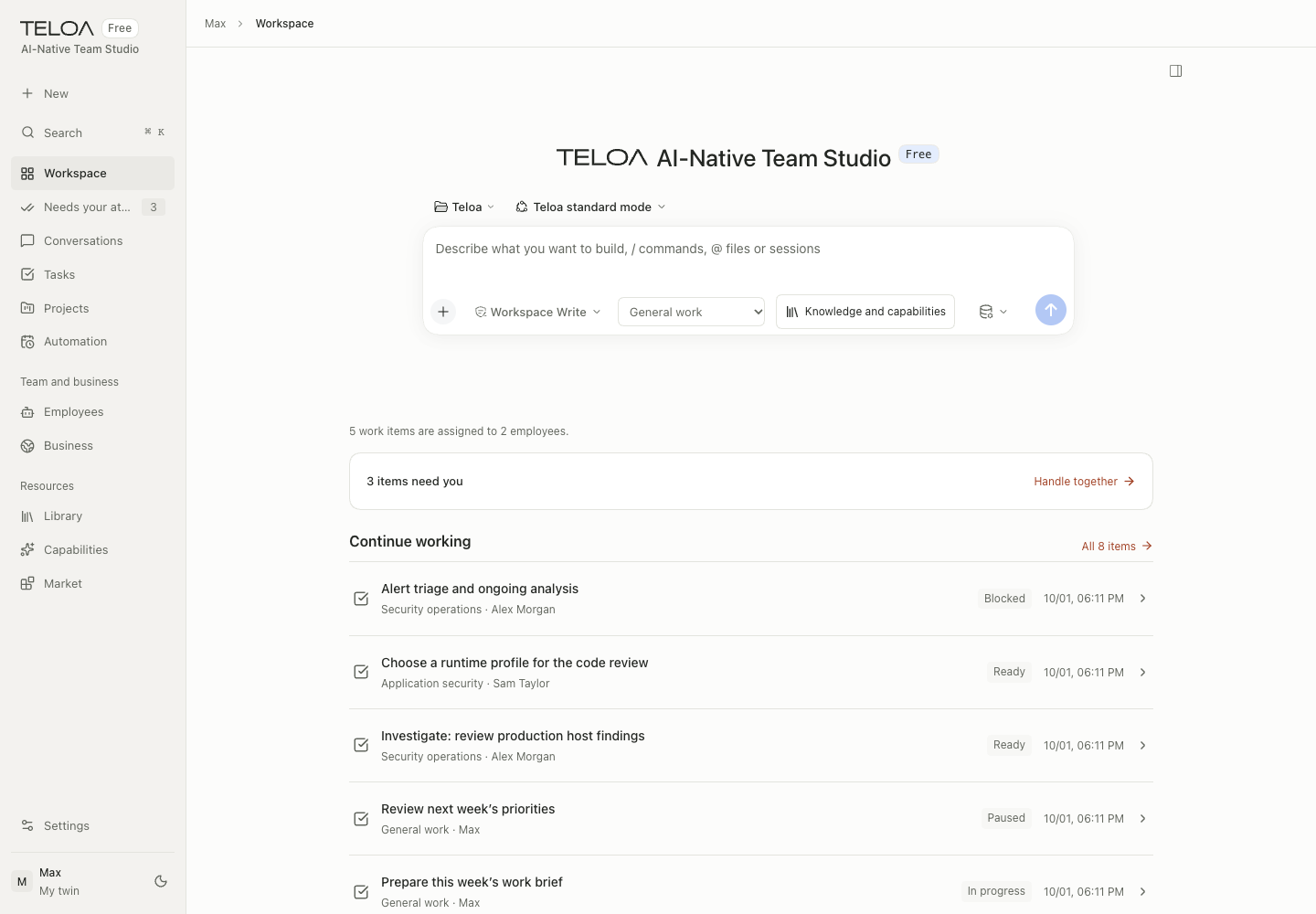
The Teloa Community workspace, shown with example data.
14 | Teloa Community Is Now Open Source
If you would like to explore this direction with us, start here:
Stars, forks, issues, and code contributions are all welcome.
In the future, we also hope to use Teloa Market to share AI employees, skills, connectors, task templates, business dashboards, and complete solutions that bring these capabilities together.
You should not have to build an AI team entirely from scratch. One day, recruiting an AI employee with an established role, capabilities, and way of working could be as straightforward as installing software today.
Teloa takes its name from the Greek word “telos”: purpose, endpoint, and ultimate direction. We want AI to organize its capabilities around a goal, collaborate, execute, and see the work through.
Over a longer timescale, this path of development could be:
Chat → Copilot → Workflow → Agent → Harness / Runtime → Personal Agent → AI Employee → AI Team → AI Organization
Today, Teloa starts with the AI team.
This open-source release is the beginning of that journey.
Teloa
AI-Native Team Studio
An AI team of your own.
Models can be replaced. Harnesses can evolve. Deployments can move. Compute can be chosen. Your AI team remains yours.
Contact Us
Email: [email protected]
Max on WeChat: neteyes