
Imagine a proposal in progress. The research employee adds a condition to a finding, but the content employee keeps writing from the earlier conclusion. When the owner notices, they have to find the original material, explain the condition, and identify the paragraph to rewrite. Both employees have done work; coordination has returned to the person.
The failure occurs at the connections between their work. Who is responsible for the update? Which version should the next contributor use? Which existing content needs another look? Several parallel windows provide few answers. If the person must remember all of this, a larger team may bring more relaying and checking.
Teloa aims to organize responsibilities that continue. After an assignment ends, its original owner, supporting material, and result should remain accessible. When similar work begins, a corrected method also needs a place to carry forward.
Why return to the same employee next time?
A temporary assistant might produce an excellent proposal. The purpose of a lasting research employee becomes clearer in the next collaboration: source standards, treatment of uncertainty, and delivery checks the user has accepted can continue to be maintained around the same role.
The name “researcher” supplies none of that by itself. What deserves to persist is a working agreement: how far to investigate, which conclusions need evidence, how to describe missing material, and what to check before handing work to the next contributor. Responsibilities, knowledge, skills, and tools help the employee fulfill that agreement.
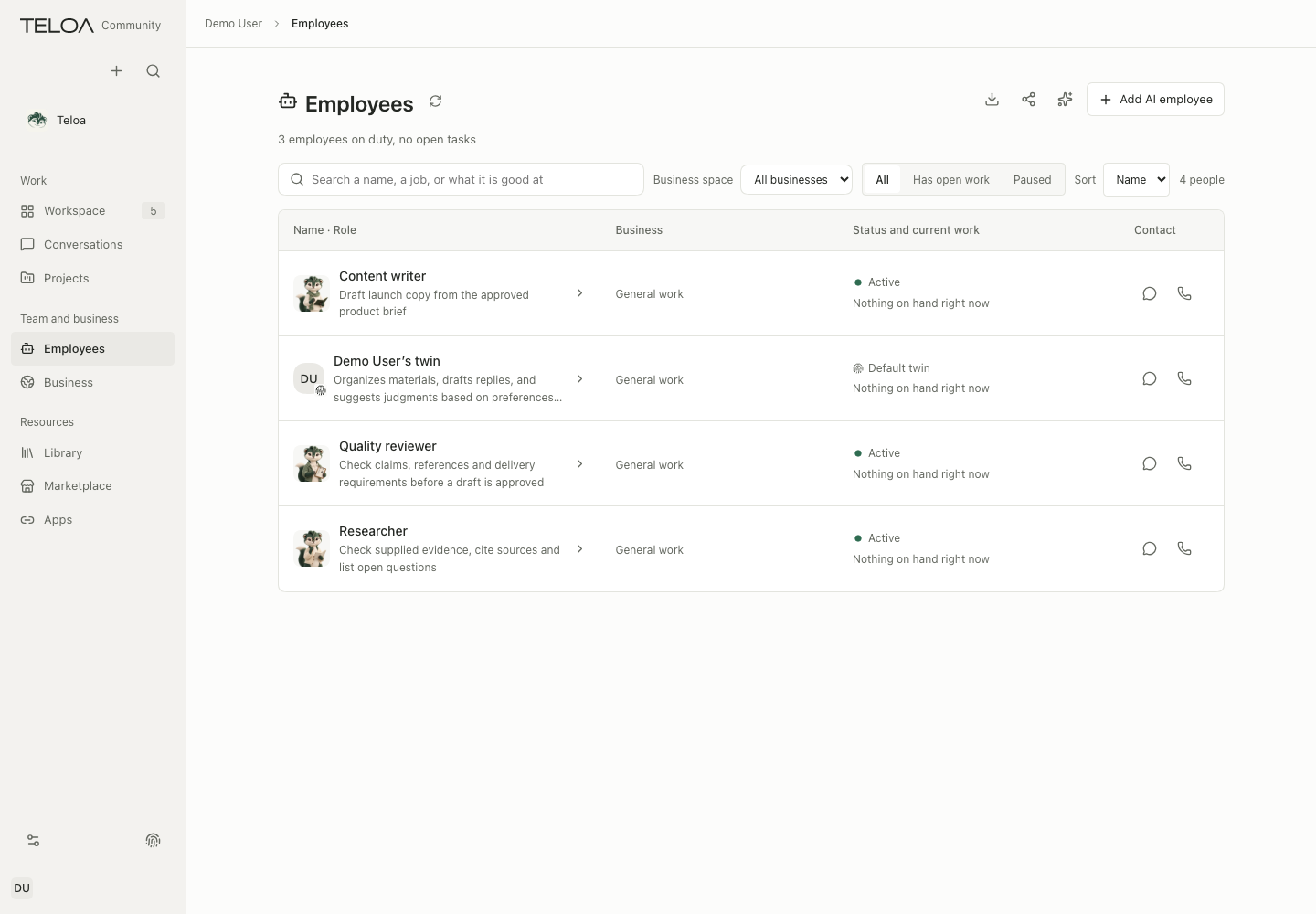
A role's identity therefore lasts beyond a run. Client material and deadlines change, research methods can be revised, and the original employee remains connected to historical deliveries. Corrections have a place for maintenance, giving the next collaboration a chance to begin with standards already developed.
Which responsibilities deserve a lasting role?
Creating an employee has a cost. Each additional role calls for decisions about overlapping responsibilities, who maintains material and methods, and how delivery reaches someone else. An occasional small question may not justify a lasting configuration.
Community supports assigning independent general-purpose work from the main chat, so a user can start with one job. When similar requirements recur and delivery standards become stable, a role becomes worth keeping. An employee should exist because some work deserves continuing responsibility, rather than because a profession is missing from the directory.
Execution capacity can also expand temporarily. A research employee checking independent sets of material can use helpers within the task, while the original employee integrates their results. Preparing inputs, waiting, and resolving conflicts all add cost. Tightly related questions may be better handled together. The work's bottleneck determines whether to split it; the lasting employee directory need not grow with each run.
Carry the conflict through the handoff
Return to the proposal. The first research version supports a shorter delivery time. The second adds “only for standard projects with complete material.” The commitment already written by the content employee needs reconsideration. Sending the new file transfers material without resolving its conflict with the existing paragraph.
A group discussion lets research explain the condition, content ask about its implications, and the owner choose the wording. Discussion preserves the reasons; an explicit assignment gives someone responsibility for the revision. Both need an appropriate weight: a question can remain part of the conversation, while a specific delivery enters a linked task.
A useful handoff explains at least three things:
- The basis to use: which artifact and version, and where the new condition appears.
- Differences to address: which existing content conflicts with that basis and which questions remain undecided.
- Delivery responsibility: who continues, what they return, and who assesses the revision.
Current group work can pin preceding results and relevant material as inputs, retaining the original work while missing conditions are resolved. Whether the changes have been correctly incorporated still needs checking in the specific delivery. Versions and links give that check definite objects; an update message does not judge every later piece of content on its own.
Let structure support coordination and leave judgment with people
Projects organize related work around a shared goal. Tasks carry specific deliveries, groups retain discussion, and artifacts store content versions. Each has a purpose here: on finding an unsuitable commitment, the owner can return to its basis and responsible employee to continue the same work.
How much structure to keep depends on the coordination burden it removes. A person leading an AI team still decides goals, risk, and which results to accept. The product takes on more of the work of finding sources, distinguishing versions, and reconnecting the original assignment. Community starts with a single-user workspace; owning a team need not begin with reproducing a company's full hierarchy.
When the same applicability condition appears in the next research task, the intended starting point is an existing role standard. When the next handoff exposes a disagreement, the owner can inspect the difference and the decision still needed. People continue to judge, with less need to relay everything from scratch. That is what can make keeping a team worthwhile compared with reopening several agents for every job.