
An “AI team” easily suggests a fixed organization chart: every executor has a role, and more processing requires more employees. Real work does not always fit that mapping.
A lasting research employee may handle a briefing alone or ask for separate checks of several sets of material. Temporary delegation changes how this task executes without changing who should be responsible next time. Binding the two would make the directory grow with every run.
Teloa distinguishes lasting employees, shared discussion, and temporary helpers within a task. They retain relationships at different timescales, allowing execution to vary while keeping an owner for delivery.
Three ways to organize work across different timescales
| Organization | Why it is created | What remains after the work ends |
|---|---|---|
| Long-term employee | A type of responsibility recurs | Role definition, versions, and applicable experience |
| Work group | Several participants need to judge together | Messages, topics, and linked work |
| Temporary execution helper | A task needs independently assigned parts | The run and returned result; no long-term role is added automatically |
A long-term employee can participate in a group and also use temporary help within a task. Group membership does not have to mirror every underlying executor. Temporary helpers do not need permanent places in the employee directory.
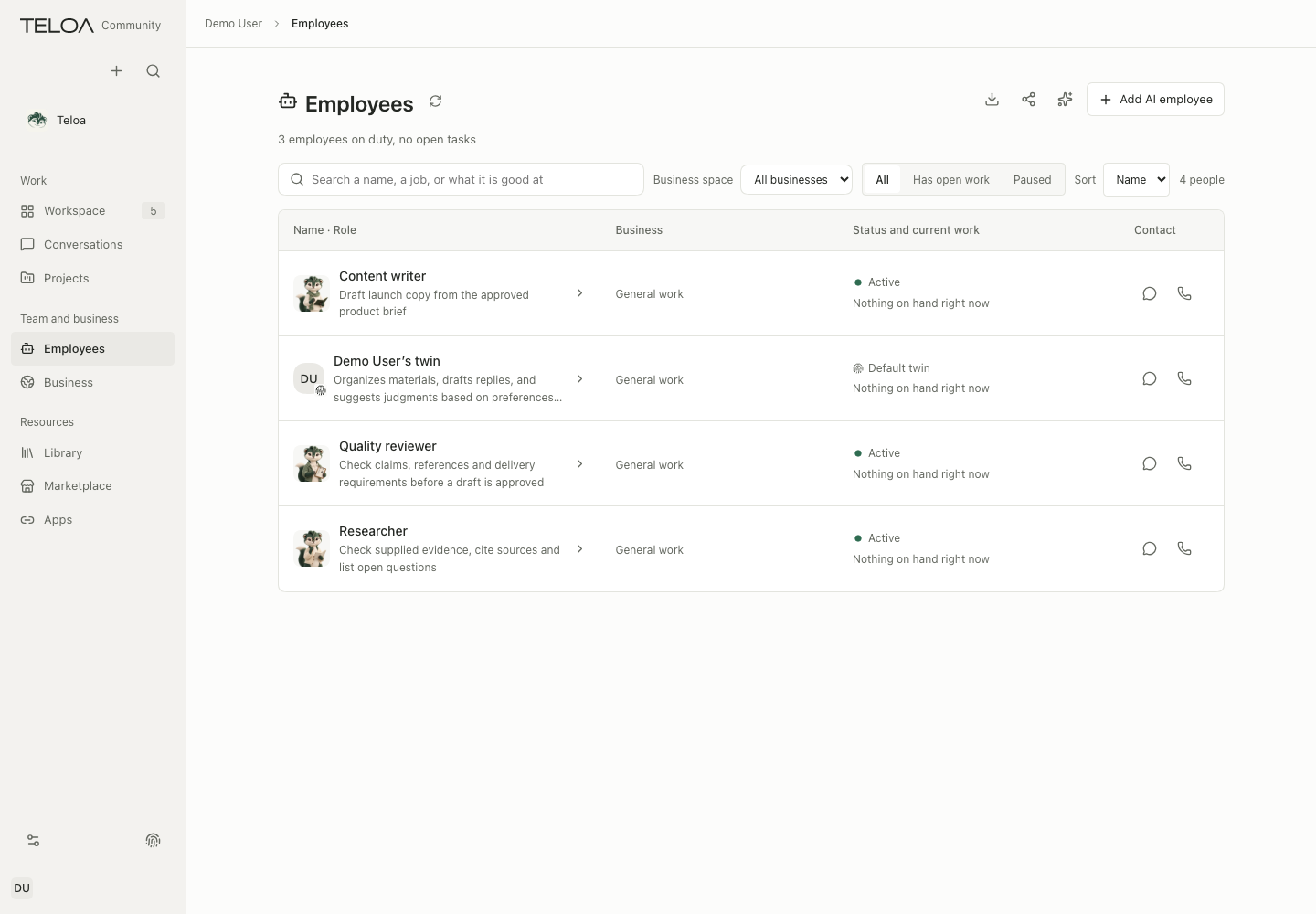
If every executor appears in the same directory, users soon struggle to tell which employees are worth keeping. Conversely, if lasting methods exist only in temporary conversations, similar work must be set up again each time. The product needs to accommodate both cases.
Define the parts of the result before dividing the work
Suppose three sets of quotes need checking. Each can be examined independently for pricing conditions, validity, and support coverage, with results returned in the same structure for the original employee to compare. The inputs and method of integration are clear.
If several helpers all receive “research these quotations and advise,” they may reread the same material and produce conflicting conclusions, leaving the person leading the work to research it again. Parallel work has increased output without reducing the time needed to finish.
Temporary assignments therefore need specific material, questions, and return requirements. Each result should have a purpose. Dividing work into more steps merely to demonstrate multiple agents adds little.
The native execution mechanisms of DeepSeek Harness (DSH) provide division of work and completion notifications within a task. Teloa preserves their relationship to the original task, responsible role, and delivery requirements, so temporary execution does not become a collection of results with no one to receive them.
Dependencies matter before splitting work. Three independent quotation sets can be checked separately. Establishing comparison criteria before writing a conclusion has an explicit order. Parallelizing the latter starts writing before its premises are settled, potentially spending the saved waiting time on rework.
A helper's assignment needs to be narrow without losing necessary context. Checking price conditions requires the comparison target, selected material, and return format; it does not require the entire private client conversation. The original employee handles cross-source conflicts. Preparing context is part of division of work, rather than copying the parent chat.
Parallel execution expands independent processing; sequential execution preserves causal dependencies. Supporting both lets the responsible employee arrange a split around the actual bottleneck, within the authorization and budget for this work. The owner sets the goal, return requirements, and investment limit. The work determines the scale of the split; the number of employees follows from that arrangement.
The original employee still has to bring the results together
Three helpers finishing their checks does not mean the comparison table is finished. Someone still needs to confirm that the conditions are comparable, explain conflicts, list gaps, and organize a usable deliverable.
The most important part of integration is handling disagreement. One helper may find no evidence while another gives a confident conclusion. The original employee needs to preserve that difference and decide whether to investigate further or qualify the conclusion. Each helper sees its assigned question; the original employee must judge whether the combined answers still address the original goal. Passing every response straight to the user can spend the time saved on manual comparison.
Some work is faster when it stays together
Parallel work carries costs in preparation, calls, waiting, and integration. Delegation is more likely to reduce completion time when inputs can be processed independently, return standards are clear, and results can be combined. Preserving sequence for dependent questions can avoid rework.
Temporary help becomes a choice around a bottleneck. Not splitting a task, splitting less, or changing the division can all be sound execution decisions. A product need not create roles merely to display more agents.
Lasting employees retain working relationships; temporary helpers provide variable processing capacity. Separating them allows a team to expand when needed and leave clear responsibility and artifacts when the work ends.