
A personal twin can write a reply that sounds like its owner and still misunderstand why the owner made that choice. Tone is visible in the result; judgment often depends on the circumstances. The same refusal might reflect a temporary lack of resources or a principle the person is unwilling to abandon.
This leads to a choice in Teloa's approach to personalization: first give people material through which to inspect and correct their choices, rather than turn a few behaviors into a complete persona. The current twin profile builds personal material from sourced judgment samples and observations of habits. Draft text supports inspecting expression; acting on the owner's behalf is handled separately through explicit tasks and delegations.
These address three different questions: Is this wording suitable? Why was this choice made? What may the twin do this time? Understanding someone over time requires an answer to each.
Two refusals do not establish one preference
Consider two hypothetical requests to bring a client delivery forward. In the first, the client wants delivery three days earlier. You agree with the arrangement and want to help, but your team is fully booked this week. You decline that date and offer to deliver part of the work next week. With different resources, the same request might receive a different answer.
In the second, the team has capacity, but the client has not defined the acceptance scope. You still decline the earlier date, because committing now could also commit you to work that remains unclear. You want to establish the scope before discussing the schedule.
Both replies might end with “We cannot bring delivery forward this time.” Keeping only that outcome could produce the generalization that you do not accept rush requests, while losing the conditions that matter to the next decision.
| Reason for declining | What to check next time | What change calls for a new judgment |
|---|---|---|
| The team has no capacity this week | Current schedules, possible delivery dates, and partial delivery | Whether reallocating resources makes the requested date or an alternative feasible |
| Acceptance scope is unclear | Whether deliverables, responsibilities, and acceptance conditions have been agreed | Reassess the date once scope is clear; extra staff alone do not complete the agreement |
The difference is not entirely a matter of personality. It concerns how you weigh a client relationship, team resources, and the risk of a commitment in a particular situation. Judgment samples should retain the basis for those differences, rather than turn a count of refusals into a stronger preference label.
Draft text supports inspection; samples preserve the reasoning
Persistent editing of draft text is an agreed design whose save path has not yet been connected for the actual twin. The existing editor shows the intended way to inspect wording; it cannot yet promise that an edit has been durably saved.
In this agreed design, draft text provides the most direct object to inspect. For the second request, you might change “We will try to arrange it” to “Let us confirm the acceptance scope first, then offer a date we can commit to.” The edit changes more than tone: it makes a condition of the commitment visible.
The personal material that can currently be maintained includes judgment samples and observations of habits. Samples can be recorded, confirmed, or withdrawn. Observations can be revisited, and content from them can be recorded as private candidates. Users can begin examining specific choices without first completing a personality questionnaire.
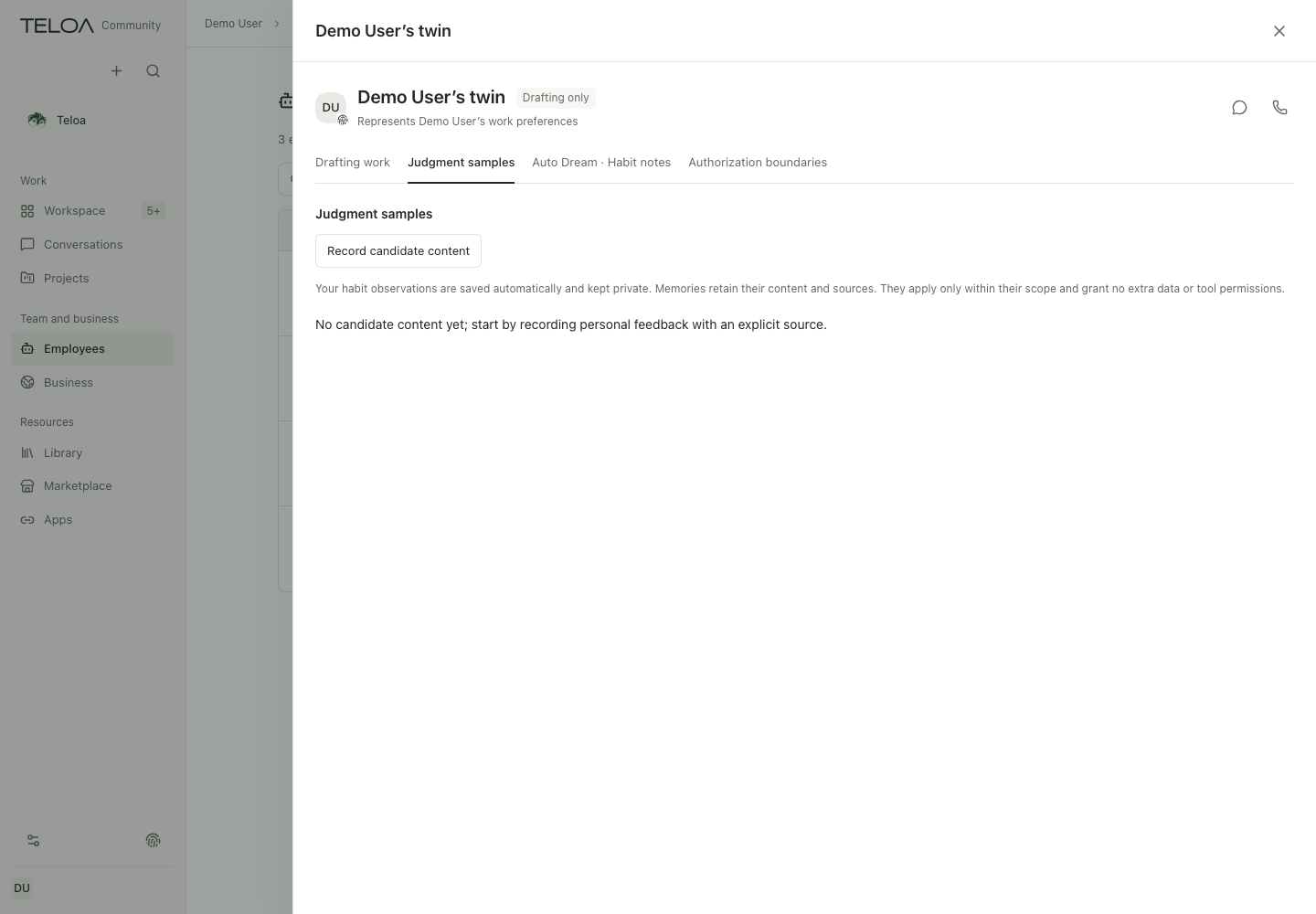
Text alone cannot explain every reason. The reply says “confirm the scope first”; a judgment sample also needs to retain the circumstances, which conditions were unclear, and why the person did not agree immediately. On returning to the sample, they can then assess whether it represents a principle that still applies or a choice specific to that arrangement.
This is why text and samples need separate maintenance. An edit to wording does not necessarily change a judgment, and a change in resources need not require rewriting every expressive habit. Combining them in an ever-growing personal description makes it hard to know what else a correction affects.
Delegation defines what may be done this time
Even if the twin understands the distinction between the two refusals, it cannot infer permission to accept the next proposed schedule for you. Understanding the reasoning can help prepare a reply; committing to a delivery date creates a new responsibility.
Expressive material, judgment samples, and execution permission therefore need separate handling. The first two support inspecting and correcting personal context without granting another power to act whenever a preference is saved. When the twin needs to take on work, that work is specified in a task or delegation.
Current twin execution authorization checks the task or delegation confirmed by the owner, the twin's identity version, and the corresponding task content or delegation version. An old confirmation does not automatically permit a new scope after content or identity changes. Execution must also meet role-status and business-scope conditions. These checks establish who agreed to which work; a personal description of how someone usually behaves cannot replace them.
In a group, the twin participates under its own identity. Other members need to distinguish material prepared by the twin from a decision made by the owner, who still makes formal approvals. Private judgment material does not automatically become shared with every member when a twin joins a group.
Correctable material comes before lasting representation
The current profile does not automatically supply its samples to every ordinary conversation. At this stage, evaluation should begin with the material: does it retain the person's actual choice, can its source be revisited, and can an unsuitable generalization be withdrawn and recorded afresh? A rich archive or familiar tone alone cannot establish that later work understands the person better.
This gives the current capability a clear relationship to the longer-term goal. Maintaining the profile first provides a basis the owner can inspect. How that material is selected and used in particular work, and whether it improves the next reply, must be evaluated through the actual paths involved. Saved content cannot simply be called learned judgment.
Return to the two rush requests. When resources become available, the first refusal should not become a reason to keep declining. When acceptance scope is still unclear, the concern behind the second should not disappear because the client presses harder. A twin worth maintaining over time needs to leave its owner room to explain those differences—and to change the choices themselves.