
Digital systems record what has happened. AI is useful for interpreting material, inferring possibilities, and suggesting next steps. Connecting them requires an early decision: should a model's judgment immediately change the business record?
A customer may be delayed without being confirmed delayed; a prepared email has not necessarily been sent. Writing every output directly to official state turns recommendations into facts too early. Leaving all analysis in reports, however, prevents AI from contributing to execution.
Action drafts connect these needs. Teloa first makes a proposed change inspectable, then executes through explicit adoption and returns the actual result to the original item. Records, analysis, and suggestions keep their meanings while AI gains a way to advance the work.
Start work from a specific record
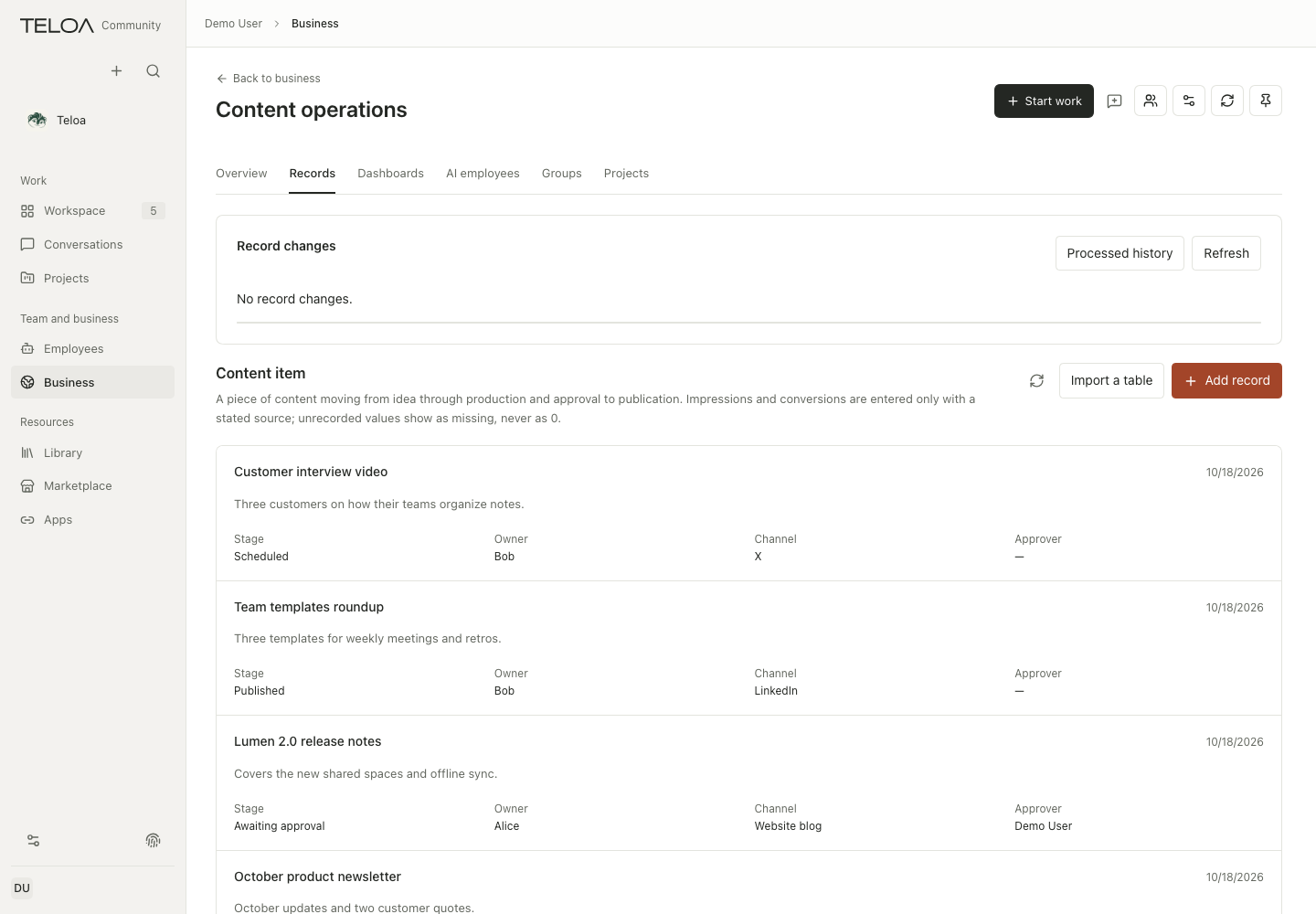
Suppose someone handling a customer quotation needs to check seat requirements and budget. The business record holds the customer and stage, material supplies the evidence, and new work starts from that record in a linked business conversation.
The work has a defined subject and a place for its result to return. The user does not have to reverse-engineer which customer a general report analyzed. Later communication can begin from the record and lead back to the original work and deliverables.
In this check, the employee compares seat counts and budget conditions in the client material with the current record, explaining what is established and what still needs asking. Analysis remains a separate summary, progress update, or fixed deliverable version. The owner can use the findings that hold before deciding to add to the record or continue communication. When more material arrives, the record leads back to the original work without another explanation of who it concerns and what was missing.
The links give the capabilities distinct contributions. The record retains business state, the employee and material explain its basis, tasks and artifacts retain the specific work, and an action draft turns the useful parts into a definite proposed change. The owner need not manually re-enter everything AI has organized, while unconfirmed inferences still have a place to remain open.
A draft turns a recommendation into an inspectable change
An employee extracts seats and budget from material and suggests adding them to the customer notes. Writing directly may seem convenient, but leaves the user no chance to catch a misunderstanding, wrong target, or excessive change before submission.
Current local record changes first prepare a persistent draft. The saved business record remains unchanged at that stage. The review entry shows the before-and-after differences, so the user can check the target, content, and scope before choosing whether to apply them.
A diff is more specific than “the customer will be updated.” It needs to show which fields will change and which will remain. When a model proposes several changes, the user should not have to reconstruct their actual effects from a paragraph of explanation.
Saving the draft also keeps the work intact during a wait. The user can leave it for later, close the view, or reload and return to the same content, without asking the model to infer its original recommendation again.
Applying a change through the original execution
After the user asks to apply the draft, the action goes through native approval in the original conversation. Approval refers to the fixed draft, version, and target. The record and application receipt are saved together. This avoids a successful write with no corresponding receipt, which could lead to the same change being applied again later.
Those fixed conditions matter. If the record changes elsewhere after review, the earlier approval cannot simply overwrite the newer state. If the response is lost, the next check should read the original receipt rather than issue a new write request.
Rejection and cancellation also have their own outcomes. Without approval, the business record is not changed and the draft remains available for review. Closing the drawer only ends viewing; it is neither approval nor rejection. Natural expression and definite actions can then remain part of the same work.
This path applies to supported business-record changes. Sending to or writing back to an external system depends on the capabilities and receipts of that particular tool. Connecting a service does not give every external action the same behavior.
This replaces repeated data entry with reviewing a proposed change. The owner checks what will change and whether its basis holds; the service handles the fixed version, actual write, and recovery of the result. The person still makes the business decision without manually transferring accepted analysis into each field.
Completing an action may leave the business matter open
The same customer follow-up contains at least three different meanings of “complete”:
| What happened | What it establishes |
|---|---|
| A note was successfully written | The record was updated |
| Sending the email produced a receipt | The sending action has a result |
| The customer explicitly accepted the quotation | The customer made an acceptance decision, a separate business fact |
Calling all three “complete” leaves the user unsure whether follow-up is still needed on reopening the customer record. Business status needs to change according to its own definitions. Tool execution cannot decide on the customer’s behalf.
Results that have occurred need to return to the original work. Supported paths let the user read deliverables and continue the conversation from the record, preserving the basis for later judgment. External actions requiring another check must be checked at their corresponding source. Unknown outcomes remain unknown.
Keep the AI’s contribution visible
A business record can develop into an entry point for continuing work: new material supports further analysis, proposed changes can be reviewed, and execution results inform official state. Each step retains its basis, and a person can adopt only the parts of an analysis that hold.
Evaluation concerns whether facts changed correctly. A write receipt establishes a write; a sending receipt establishes the result of sending; customer acceptance needs its own basis. A completed action and business success have different meanings.
These distinctions matter more as AI participates more deeply. They allow active preparation and execution without compressing interpretation, recommendation, and external outcome into a premature “done.”